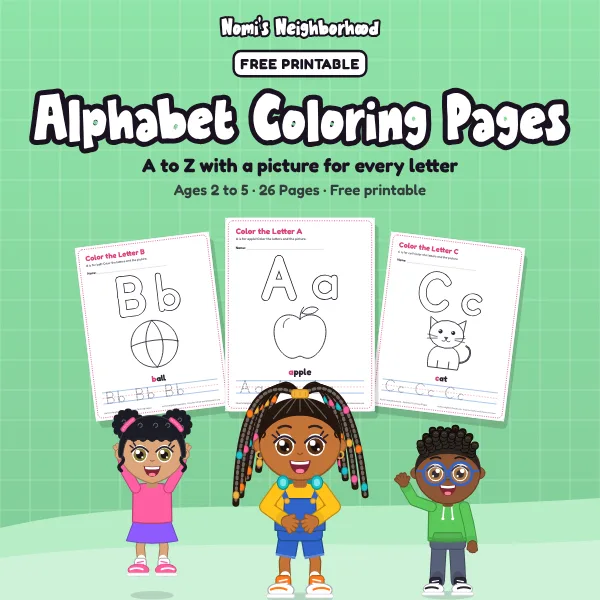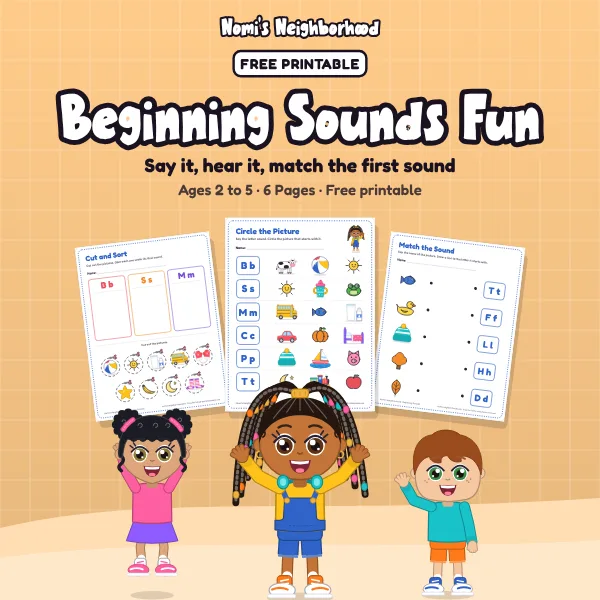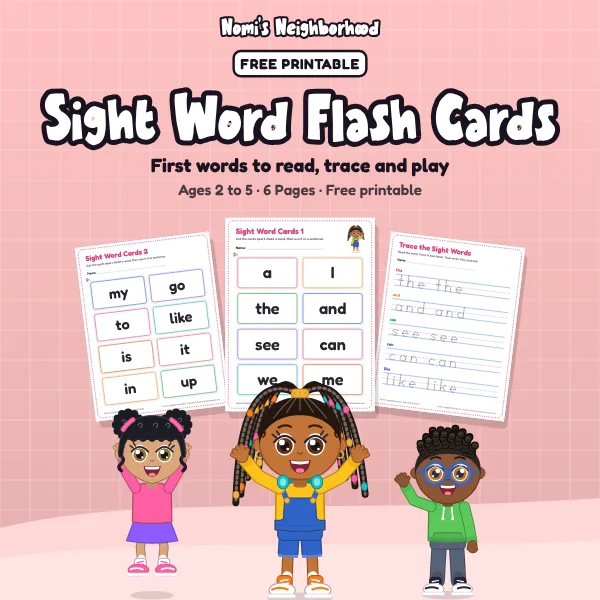
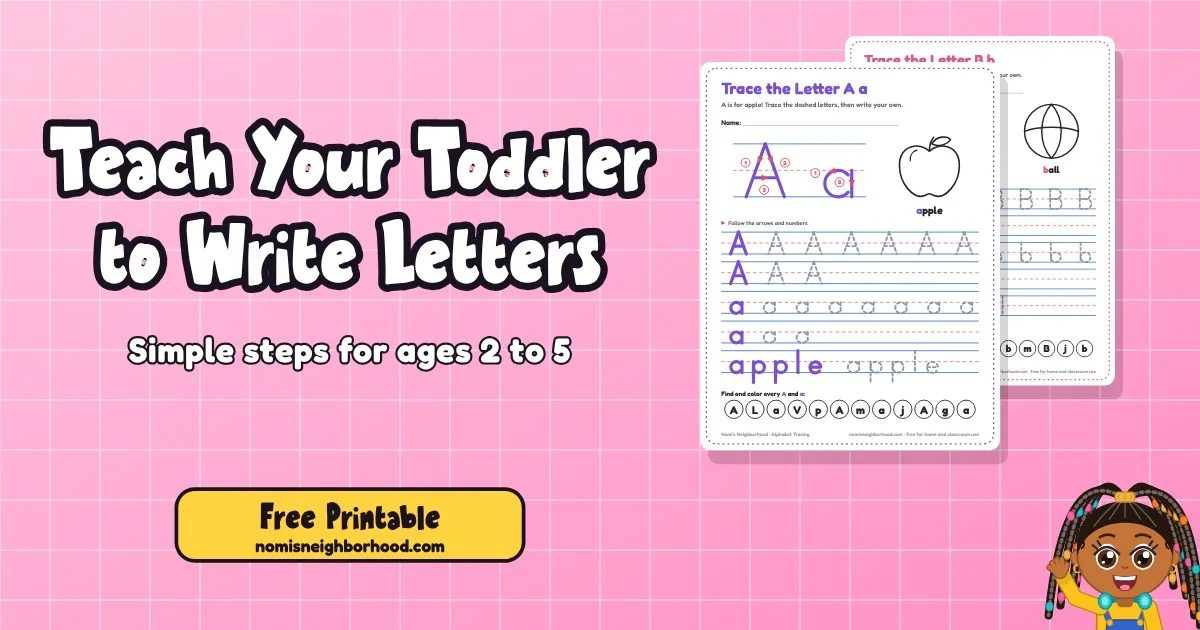
The best way to teach a toddler to write letters is to build up in small steps: strong hands first, then simple lines, then tracing letters, and finally writing letters on their own. Most 2-year-olds are ready for scribbling and big strokes, many 3-year-olds can trace simple lines and shapes, and 4- and 5-year-olds are often ready to trace and copy real letters. If you are wondering how to teach toddler to write letters without tears, the secret is to go slow, keep it playful, and follow your child's lead.
There is no race here. A child who loves drawing circles at 3 is doing real writing work, even if no letters show up yet.
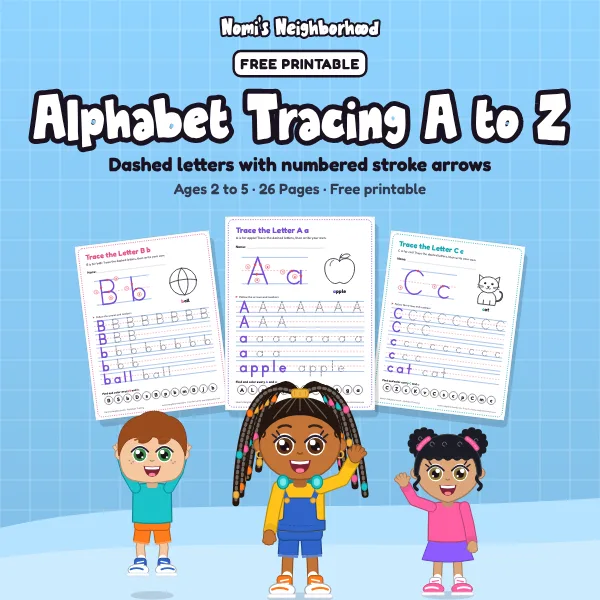
Alphabet Tracing Worksheets A–Z
Download FreeWhen Do Toddlers Start Writing Letters?
Every child is different, so think of ages as rough guides, not deadlines.
- Age 2: Scribbling, banging crayons, making marks on paper. Some kids start copying a straight line down.
- Age 3: Drawing lines up and down and side to side, starting to draw circles, maybe tracing a few big letters.
- Ages 4–5: Copying a cross and a square, tracing most capital letters, and writing a few letters (often the ones in their own name) without help.
If your 2-year-old only wants to scribble, that is exactly right. Scribbling is how hands learn to control a crayon.
Step 1: Build Hand Strength Before the Pencil
Writing takes a lot of small muscles working together. Before you hand over a worksheet, spend time on play that builds those muscles. A few easy ideas:
- Squeeze and roll playdough into snakes and balls.
- Tear paper into strips for a collage.
- Pick up pom-poms or cereal with fingers or kid tongs.
- Peel stickers and press them onto a page.
- Paint on a wall easel or a taped-up sheet of paper, which helps wrists and shoulders too.
For more ideas using things you already have, see our list of fine motor activities for toddlers.
Step 2: Teach Pre-Writing Strokes
Every letter is made of a handful of simple strokes. Kids who can draw these comfortably have a much easier time with letters later. Practice them in this rough order:
- Vertical line (top to bottom)
- Horizontal line (left to right)
- Circle
- Cross (plus sign)
- Diagonal lines
- Square
- X
- Triangle
Make it a game. Draw "rain" falling down, "roads" going across, and "bubbles" for circles. We go deeper on this in our guide to pre-writing strokes for toddlers.
Step 3: Use the Right Tools and Grip
Small tools are easier for small hands. Try chunky crayons, broken crayon pieces, short pencils, or triangle-shaped crayons. Short tools naturally push kids toward a pinching grip.
Don't worry if your 2-year-old holds the crayon in a fist. That is a normal stage. Over time, most kids move toward holding it with the thumb and fingers. You can gently model the grip, but there is no need to correct it over and over at this age.
Working on a slanted surface, like a big binder turned sideways or an easel, also helps wrists stay in a good position.
Step 4: Start Letters with Big, Messy Practice
Before paper and pencil, let kids "write" letters with their whole body and senses:
- Draw letters with a finger in a tray of salt, sand or flour.
- Write giant letters with sidewalk chalk and walk along them.
- Build letters with play dough snakes or wooden sticks.
- Paint letters with water on a fence or sidewalk.
- Trace letters on your child's back and let them guess.
This kind of play helps kids learn the shape and the movement before they worry about staying on a line.
Step 5: Move to Tracing Dashed Letters
Once your child can draw lines and circles, it's time for tracing. Use worksheets with dashed letters on handwriting lines and a big model letter with numbered arrows that shows where to start. Teach these three simple rules:
- Start at the top of the letter.
- Go top to bottom.
- Go left to right.
Those rules match how letters are formed in school, so your child won't have to unlearn habits later. Say the strokes out loud as you go: "Big line down. Jump back to the top. Little line across."
Which Letters Should Toddlers Learn First?
Many families start with capital letters because they are made mostly of straight lines and big curves. A good order to try:
- Letters with straight lines only: L, T, E, F, H, I
- Letters with diagonals: A, V, W, X, Y, Z, K, M, N
- Letters with curves: C, O, D, P, B, R, S, G, J, Q, U
Another great starting point is the letters in your child's name. Kids light up when they can write something that belongs to them. Our post on name tracing for preschool has tips for that.
Step 6: Copy, Then Write Alone
After tracing feels easy, the next step is copying. Write a letter at the top of the page and have your child copy it underneath. Then, when they're ready, ask them to write a letter from memory.
Keep sessions short. For most 3- and 4-year-olds, five to ten minutes is plenty. Stop while they're still having fun, so they want to come back tomorrow.
Age-by-Age Guide to Letter Writing
Age 2
Focus on scribbling, playdough, finger painting and big arm movements. Say letter names while you play, sing the alphabet song, and point out letters on signs and books. Watching a fun alphabet song together, like Nomi's "ABC Bounce," can make letter names feel familiar. You can watch Nomi on YouTube and then pause to draw the letter you just sang.
Age 3
Work on lines, circles and crosses. Try finger-tracing letters in sand. Offer a few tracing pages with big dashed capital letters, but let your child choose when to stop.
Ages 4–5
Trace the full alphabet, copy letters, and start writing their name. Introduce lowercase letters once capitals feel solid. Praise effort ("You started right at the top!") more than neatness.
Common Mistakes to Avoid
- Pushing too early. If your child gets upset, step back to play-based practice for a while.
- Long sessions. Short and happy beats long and frustrating.
- Correcting every wobble. Wobbly letters are normal. Celebrate the try.
- Skipping the start point. Starting at the bottom is a habit that's hard to break, so point to the first numbered arrow every time.
- Only using worksheets. Mix in chalk, sand, paint and playdough so practice stays fresh.
Make It Part of Your Day
Letter practice doesn't need a set lesson time. Let your child "write" the grocery list next to you. Trace letters on foggy windows. Make a birthday card and add the first letter of the person's name. These little moments add up, and they show your child that writing is useful and fun.
Alphabet Tracing Worksheets A–Z
Download FreeFAQ
What age should a toddler start writing letters?
Most children start tracing letters around 3 to 4 and writing a few on their own between 4 and 5. Before that, scribbling and drawing lines are the real work, and they matter just as much.
Should I teach uppercase or lowercase letters first?
Many families and teachers start with uppercase letters because they use simpler straight lines and big curves. Once capitals feel easy, add lowercase letters, starting with the ones in your child's name.
How do I get my toddler to hold a pencil correctly?
Offer short, chunky crayons or broken crayon pieces, which encourage a pinch grip. A fist grip is normal for 2-year-olds. Model the grip without forcing it, and keep building hand strength with playdough and stickers.
How long should toddler writing practice last?
Five to ten minutes is plenty for most 3- and 4-year-olds. Stop while your child is still enjoying it, and practice a little most days instead of a lot at once.