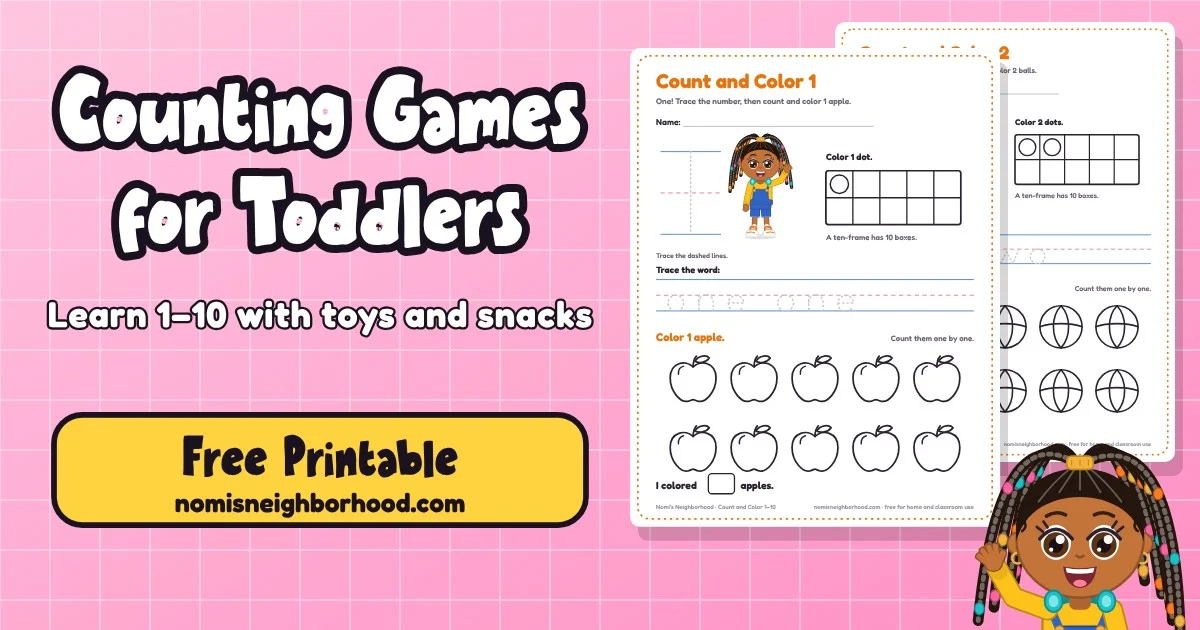
Part of our Early Math learning hub: more printables, guides and episodes on this topic.
The best counting activities for toddlers are short, hands-on games that use real objects: snacks, toys, stairs and fingers. Count out loud together, touch each item as you say a number, and keep it playful. Most toddlers start by reciting numbers like a song, and real understanding comes later through lots of everyday counting.
You do not need flash cards or a special kit. A bowl of cereal and a few minutes of attention will do more than a stack of worksheets.
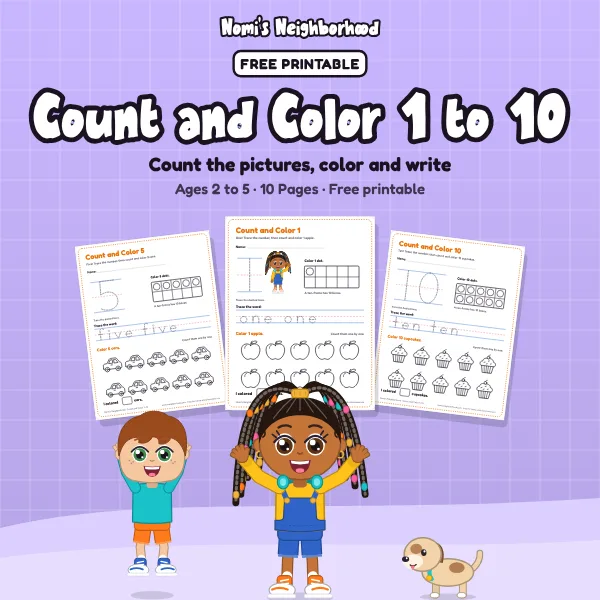
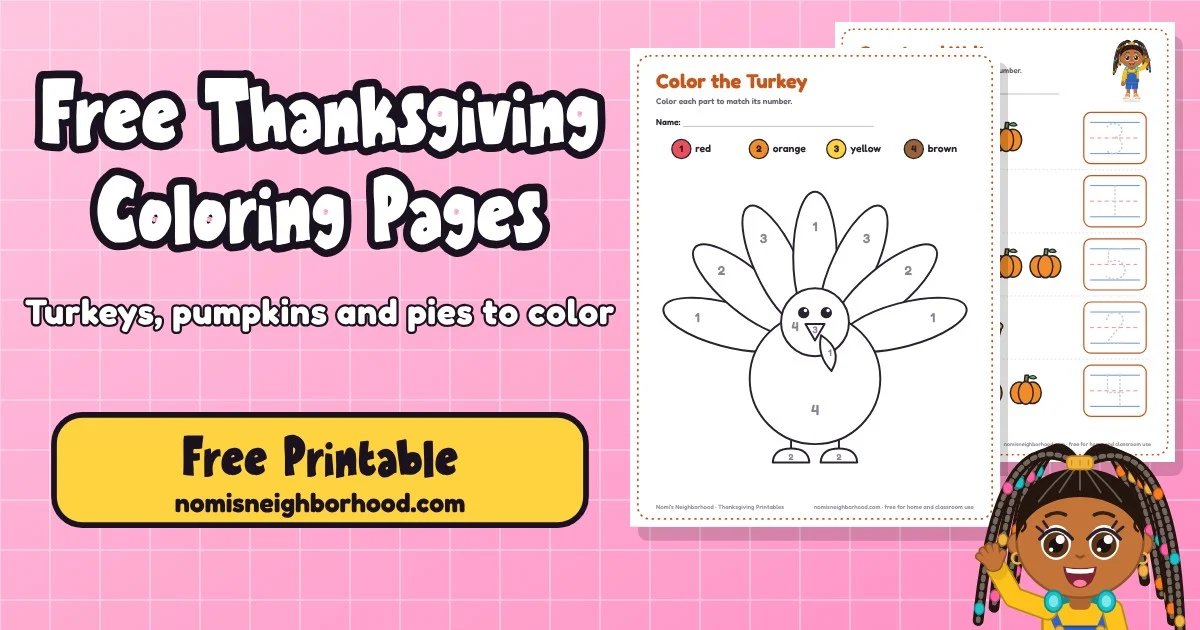
Count and Color 1–10 Worksheets
Download FreeHow Toddlers Learn to Count
Counting is actually a few skills stacked together. Knowing them helps you pick the right activity.
- Rote counting. Saying "one, two, three" in order, like a song. Many 2-year-olds can do a few numbers this way.
- One-to-one correspondence. Touching one object for each number said. This usually takes a lot of practice.
- Cardinality. Understanding that the last number you say tells you how many there are. "One, two, three. Three ducks!"
- Number recognition. Knowing what the written numeral 3 looks like.
Every child moves through these at their own pace. Some 3-year-olds count to 20 out loud but still skip objects when counting a pile. That is completely normal.
Counting Activities for Toddlers by Age
Age 2: Hear It and Say It
At two, the focus is on hearing numbers often. Keep counts small, usually one to three or one to five.
- Count the stairs. Say each number as you climb together.
- Snack counting. "You have one, two, three crackers!" Then eat them one at a time and count down.
- Finger songs. Songs like "Five Little Ducks" pair numbers with motion.
- Sock counting. While doing laundry, count socks as you toss them in the basket.
Age 3: Touch and Count
Three-year-olds are ready to practice touching each object while counting.
- Muffin tin counting. Drop one pom-pom in each cup while counting out loud.
- Toy car parking lot. Draw numbered parking spots on paper and "park" cars one by one.
- Block towers. Count each block as you stack. Count again when it falls down (the best part).
- How many jumps? Jump and count together. Try claps, stomps and spins too.
Ages 4–5: Count, Match and Compare
Older preschoolers can start matching amounts to numerals and comparing groups.
- Number hunt. Write 1 to 10 on sticky notes. Hide them and have your child find them in order.
- Count and sort. Sort buttons or blocks by color, then count each group. Which group has more?
- Playdough numbers. Roll a number card, then make that many playdough balls.
- Counting walks. Count trees, red cars or dogs on your walk. Keep a tally with chalk.
Everyday Counting Games That Feel Like Play
The secret to teaching counting is weaving it into your normal day. Here are easy moments to grab:
- Bath time. Count rubber ducks, cups of water or toes.
- Getting dressed. Count buttons, snaps or how many arms go in the sleeves.
- Setting the table. "We need four spoons. Can you count them out?"
- Grocery store. Count apples into the bag or boxes in the cart.
- Clean-up time. "Let's put away five toys. Ready? One..."
- Car rides. Count stop signs or yellow cars.
These little moments add up. Numbers start to feel useful, not just something to memorize.
Fun Ways to Teach One-to-One Counting
One-to-one correspondence is where many toddlers get stuck. They say numbers faster than they touch objects, or they count the same block twice. A few tricks help:
- Line it up. Put objects in a straight row instead of a pile. Rows are easier to count.
- Move it as you count. Slide each object from one side of the table to the other as you say its number.
- Go slow. Model counting slowly and clearly. Your child will copy your pace.
- Use bigger objects. Large blocks are easier to touch one at a time than small beads.
- Count back. After counting, ask, "How many?" and repeat the last number with excitement.
Songs and shows help too. Nomi's "Duck Pond Day" episode mixes counting with animal sounds, so it pairs well with a hands-on follow-up. You can watch Nomi on YouTube together, then line up rubber ducks in the bath and count them one at a time.
Using Worksheets the Right Way
Worksheets are not where counting starts, but they can be a nice way to practice after lots of hands-on play. Count-and-color pages work well for 3- to 5-year-olds because they combine counting with something relaxing.
Tips for using them:
- Have your child touch each picture with a finger before coloring.
- Keep it to one or two pages at a time.
- Let them use real objects to check their answer if they want.
- Stop while it is still fun.
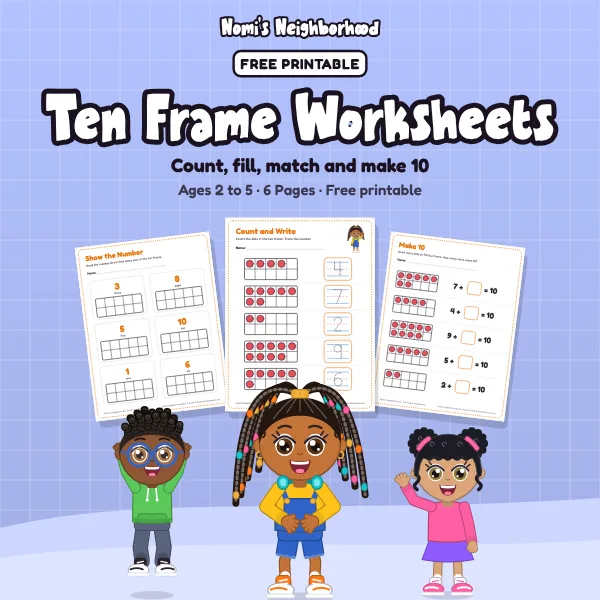
For older preschoolers who are ready for more structure, ten frame activities are a great next step. They help kids "see" numbers in groups of five and ten.
Signs Your Toddler Is Making Progress
You might notice your child:
- Counting things on their own without being asked
- Saying "more" or "less" when comparing groups
- Holding up fingers to show their age
- Noticing numbers on signs, doors or clocks
- Correcting you when you "accidentally" skip a number
Celebrate these moments. A simple "You counted all by yourself!" goes a long way.
What to Avoid
A few things can make counting feel stressful:
- Long drills. Five minutes of play beats twenty minutes of flash cards.
- Correcting every mistake. Just model the right way and keep going.
- Comparing kids. Your child's pace is their own.
If you want a deeper look at building number sense without pressure, read our guide on how to teach numbers to toddlers. And for more everyday learning ideas, check out toddler learning activities at home.
Count and Color 1–10 Worksheets
Download FreeFAQ
At what age should a toddler count to 10?
Many children can recite numbers to 10 somewhere between ages 3 and 4, but there is a wide range. Counting 10 objects correctly often comes a bit later. Lots of everyday practice matters more than hitting a specific age.
How do I teach my 2-year-old to count?
Count out loud during daily routines like climbing stairs, eating snacks and bath time. Keep numbers small, from one to three or five, and point to each item as you say the number.
Why does my toddler skip numbers when counting?
Skipping numbers is very common while kids are still learning the counting sequence. Model counting slowly, line objects up in a row, and count together often. It usually smooths out with practice.
What are good counting toys for toddlers?
Simple items work best: blocks, stacking cups, toy cars, pom-poms, and large beads with supervision. Anything your child can touch and move one at a time makes a good counting tool.