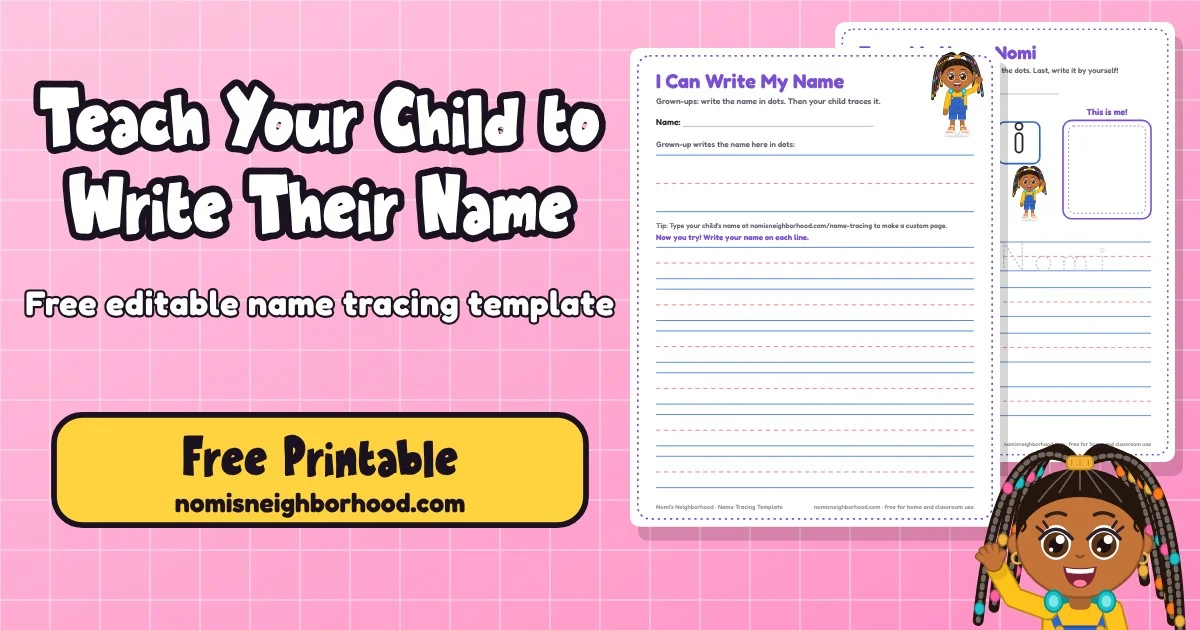
Part of our Early Literacy learning hub: more printables, guides and episodes on this topic.
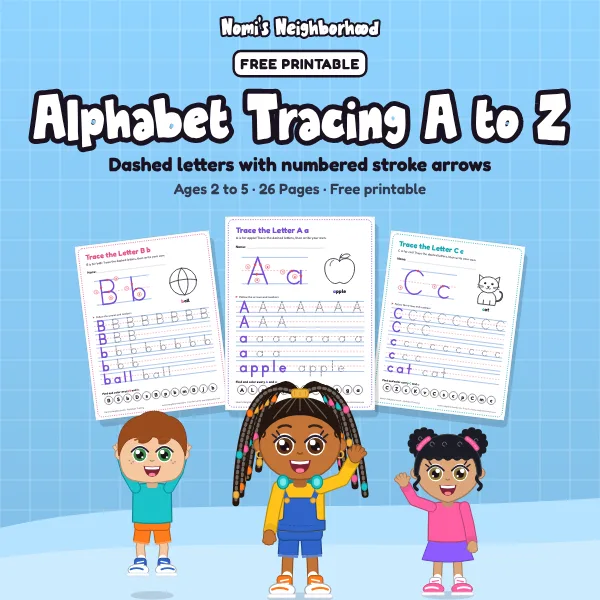
Name tracing worksheets help preschoolers learn to write their name by tracing dashed letters on handwriting lines. Start at the top of each letter, and trace top to bottom and left to right. Write the first letter as a capital and the rest in lowercase, and practice a little each day instead of a lot at once.
For many kids, their name is the very first word they write. It is personal, it is everywhere, and they are proud of it. That makes it the perfect place to begin.
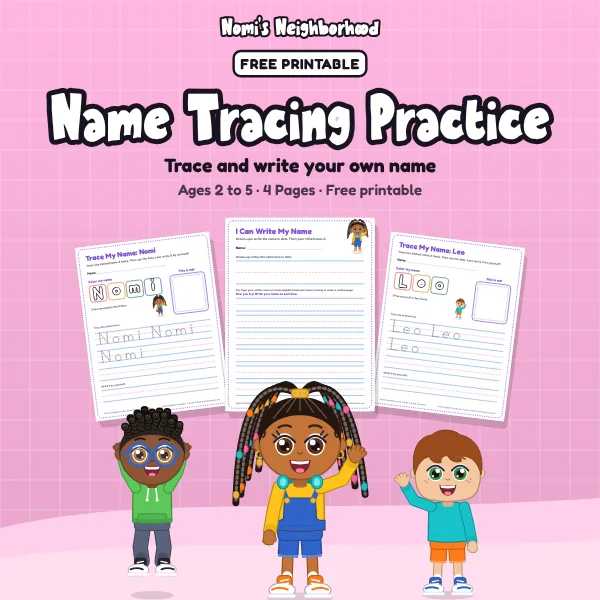
Editable Name Tracing Template
Download FreeWhen Should a Child Write Their Name?
Every child is different, but here is a loose guide:
- Age 2: Most toddlers are still scribbling. Focus on recognizing their name and making marks.
- Age 3: Many kids recognize their name in print. Some may try the first letter.
- Age 4: Many children start writing some or all of their name, often with wobbly or backward letters.
- Age 5: Many kids can write their first name, though spacing and letter size may still be uneven.
If your child is not there yet, that is okay. Name writing depends on fine motor strength, hand control and interest, and those grow at different speeds.
Before Tracing: Build the Basics
Kids who jump straight into tracing letters can get frustrated. A little groundwork helps.
Pre-Writing Strokes
Letters are made of simple lines: up and down, side to side, circles and slants. Practicing these first makes letters much easier. Our post on pre-writing strokes for toddlers explains which lines to start with.
Hand Strength
Small hands need strength to control a crayon. Playdough, tongs, stickers and tearing paper all help. You can find easy ideas in our fine motor activities for toddlers post.
Name Recognition
Before writing their name, kids should be able to spot it. Label their cup, cubby or bedroom door. Point it out often.
How to Use Name Tracing Worksheets Step by Step
- Write their name the right way. Use a capital first letter and lowercase for the rest, like "Maya," not "MAYA." This matches what they will see in school.
- Use dashed letters on handwriting lines. Dashed letters show the path. Handwriting lines show where letters start and stop.
- Start at the top of the letter. Each letter has a starting point, marked by the first numbered arrow. Teach your child to find it at the top of the letter and begin there.
- Trace top to bottom, left to right. Most letter strokes start at the top. Say it out loud as you model: "Start at the top, pull down."
- Trace a few times, then stop. Two or three tries is plenty for one sitting.
- Celebrate effort. Wobbly letters are progress. Praise the trying, not just the result.
Tips for Tricky Letters
Some letters in names are harder than others.
- Letters with diagonals (K, M, N, W, Y, A): These take more control. Practice slanted lines on their own first.
- Round letters (a, o, e, c): Many kids go the wrong way around. Model starting at the top and going "back," like the start of a C.
- Long names: Break them into chunks. Practice the first three letters this week and add more later.
- Similar letters (b and d): Lots of practice and patience. Reversals are very common at this age.
Fun Ways to Practice Writing Their Name
Worksheets are great, but mixing in playful practice keeps kids interested.
Name Puzzles
Write their name on a strip of cardstock and cut between the letters. Your child puts it back in order.
Rainbow Tracing
Have your child trace their name on the worksheet with one color, then trace again with another. It becomes a rainbow name.
Playdough Names
Roll playdough into snakes and shape each letter on top of a large printed name.
Salt Tray Writing
Pour salt or sand into a shallow tray. Show the name on a card and let your child copy it with a finger.
Name Hunt
Write their name letters on sticky notes and hide them around the room. Find them, then line them up in order.
Sign Your Art
Have your child "sign" each drawing they make, even if it is just the first letter. Real reasons to write are motivating.
Name Tracing by Age
Age 2–3: Recognition and Play
At this age, skip formal tracing. Instead, let kids find their name, build it with letter magnets and make marks on paper. If they want to trace the first letter, that is a bonus.
Age 3–4: First Letter and Short Names
Try tracing just the first letter of their name on a worksheet. Short names can be traced fully. Use large dashed letters and a chunky crayon.
Age 4–5: Full Name Practice
Kids can practice their whole first name. Move from tracing to copying under a model, then to writing it on their own. A short daily routine, like writing their name on their snack placemat, works well.
Grip and Posture Tips
Good habits now make writing easier later.
- Sit at a table with feet supported if possible.
- Use short crayons or golf-sized pencils. They naturally encourage a better grip.
- Encourage a "pinch" grip with thumb and pointer finger, with the pencil resting on the middle finger.
- Have the non-writing hand hold the paper still.
Do not stress if the grip is not perfect yet. Fine motor play builds it over time.
When Your Child Resists
Some kids just do not want to write. That is normal.
- Keep sessions very short, one or two minutes.
- Try a different tool: chalk, a dry-erase marker or a paintbrush.
- Make it part of play, like writing a "ticket" for a pretend train.
- Take a break for a week and try again.
Pushing too hard can make writing feel like a chore. Gentle, regular practice wins. If your child is ready to move beyond their name, our guide on how to teach a toddler to write letters walks through the next steps.
Editable Name Tracing Template
Download FreeFAQ
Should my child write their name in all capitals?
It is best to teach a capital first letter followed by lowercase letters. This is how names appear in books and in school, and it saves your child from relearning later.
How do I make an editable name tracing worksheet?
Use an editable template where you type your child's name and it appears in dashed letters on handwriting lines. Our free editable name tracing template does this for you.
What age should a child be able to write their name?
Many children start writing some or all of their name between ages 4 and 5. Some do it earlier and some later. Fine motor play and regular practice help most.
Is it okay if my child writes letters backward?
Yes. Letter reversals are very common in preschool and kindergarten. Keep modeling the correct way and practicing, and most kids sort it out over time.