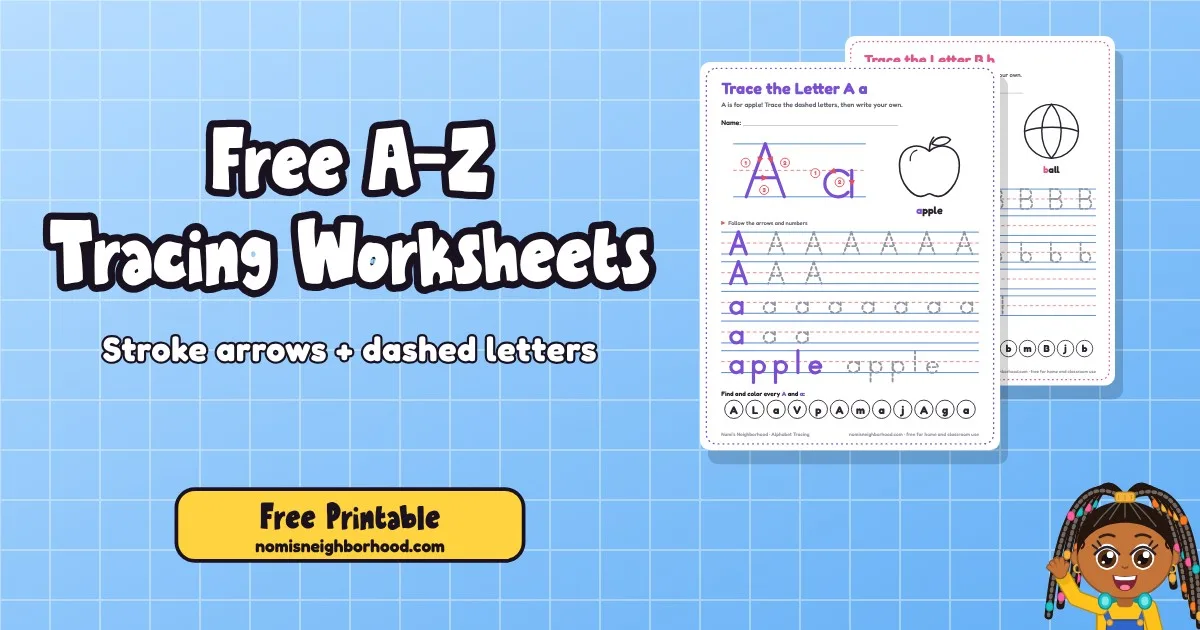
Looking for free alphabet tracing worksheets for your preschool or pre-K class? Our A–Z set gives each letter its own page with dashed letters on handwriting lines, numbered arrows that show where to start, and plenty of room for small hands. Below you'll find how the pages are set up, the best order to teach letters, and easy ways to fit tracing into centers, small groups and morning work.
These pages are designed for real classrooms: quick to print, easy to explain, and simple enough that kids can work on their own after a short demo.
Alphabet Tracing Worksheets A–Z
Download FreeWhat's Inside the Free Alphabet Tracing Worksheets
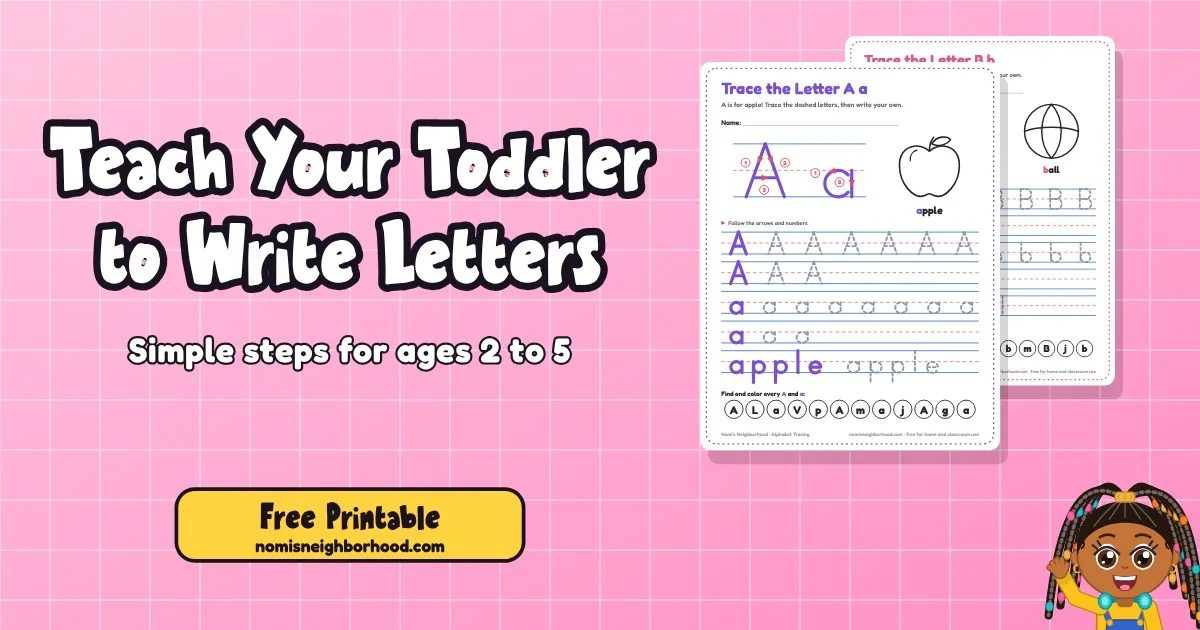
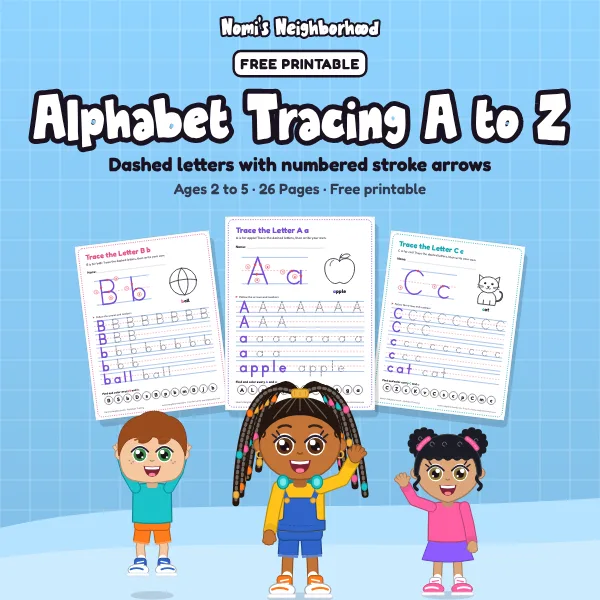
Each page follows the same simple layout, so kids know what to expect by the third or fourth letter:
- A large model letter at the top for finger tracing.
- Dashed letters on handwriting lines with a top line, a dashed middle line and a baseline.
- Numbered stroke-order badges and red arrows on the big letter so children always know where to put their pencil down and which way to go.
- A row to try alone, for kids who are ready to write without the dashes.
- A simple picture that begins with the letter, which kids can color when they finish.
The repeated layout matters. When children don't have to figure out a new page every day, they can put all their focus on forming the letter.
Why Dashed Letters and Stroke Arrows Work
Young learners need clear, simple rules. We teach three:
- Start at the top of the letter.
- Go top to bottom.
- Go left to right.
Dashed letters give kids a path to follow without making them feel like they are just coloring in a shape. That's why we skip outlined or "bubble" style letters. Kids tend to color inside those instead of practicing the actual stroke. A dashed line pushes them to make the same motion they'll use when writing on their own.
The handwriting lines also start building an early sense of size and placement, like which letters touch the top line and which stop at the middle.
The Best Order to Teach Letter Tracing
You can go A to Z, and plenty of teachers do. But if you want to make early wins easier, try grouping letters by how they are formed.
Group 1: Straight Lines
L, F, E, H, T, I
These use only vertical and horizontal lines, so they are the easiest place to start.
Group 2: Slanted Lines
V, W, X, Y, Z, N, M, K, A
These add diagonal strokes. Point out that each one still starts at the top.
Group 3: Curves
C, O, Q, G, S, D, P, B, R, J, U
Curves are the hardest, so save them for when kids feel confident. C is a great bridge because it leads right into O, G and Q.
Once capitals are going well, move to lowercase. Our guide to lowercase letter tracing worksheets explains how to teach a to z the right way.
How to Use Tracing Worksheets in the Classroom
Model It First
Before handing out pages, trace the letter big on chart paper or a whiteboard. Talk through each stroke: "Start at the top. Big line down. Back to the top. Line across." Then have kids "sky write" the letter in the air with their pointer finger.
Finger Trace, Then Crayon
Have children trace the large model letter with a finger two or three times before picking up a crayon. This helps them learn the motion before they worry about control.
Use Short, Chunky Tools
Short crayons, golf pencils and triangle crayons are easier to grip than long pencils. They also nudge kids toward a pinch grip without much correcting.
Keep It Short
One page is plenty for most preschoolers. Some 3-year-olds may only finish the first row, and that's fine. Quality beats quantity.
Five Ways to Fit Tracing Into Your Day
- Morning work: Set a tracing page at each seat for kids to start as they arrive.
- Writing center: Keep a bin of letters with crayons and a "finished" folder.
- Small groups: Work with 3 or 4 kids so you can watch start points and stroke direction.
- Letter of the week: Pair the page with a read-aloud, a sensory bin and a craft for the same letter.
- Dry-erase practice: Slip pages into sheet protectors so kids can trace again and again with dry-erase markers.
If you're setting up stations, our post on preschool centers ideas has more ways to organize a writing center.
Make Tracing Multi-Sensory
Worksheets work best as one part of letter learning, not the whole thing. Mix in:
- Tracing letters in a salt or sand tray
- Building letters with playdough snakes
- Forming letters with wooden craft sticks
- Painting letters with water on the chalkboard
- Walking along giant letters made with painter's tape on the floor
Pairing these with letter names and sounds helps kids connect the shape to what it means. For more playful ideas, see our letter recognition activities.
Music is another easy way to bring letters to life. Many classes enjoy singing along with Nomi's "ABC Bounce" song before tracing time. You can watch Nomi on YouTube on your classroom screen as a quick warm-up.
Differentiating for Different Ages
3-Year-Olds
Focus on finger tracing and the first dashed row. Praise any attempt that begins near the top of the letter. Many 3s are still working on lines and circles, so it's okay to pause letter tracing and go back to strokes.
4-Year-Olds
Most can trace a full page with some help. Watch for kids starting at the bottom, and gently redirect them to the top of the letter.
5-Year-Olds and Kindergarten Prep
Encourage the "try it alone" row. Add a challenge, like writing the letter three times and circling their best one.
Tips for Checking Student Work
You don't need to grade tracing pages. Instead, look for a few things while kids work:
- Did they start at the top of the letter?
- Are they moving top to bottom and left to right?
- Are they holding the crayon with fingers rather than a full fist (for older 4s and 5s)?
Jot quick notes if you like. Patterns, like a child who always starts at the bottom, are much easier to fix early.
Alphabet Tracing Worksheets A–Z
Download FreeFAQ
Are alphabet tracing worksheets good for preschoolers?
Yes, when used in short sessions alongside hands-on play. Tracing helps kids learn where letters start and which way strokes go. Pair it with sensory activities like sand trays and playdough for the best results.
Should preschoolers trace uppercase or lowercase letters first?
Most preschool teachers start with uppercase because the strokes are simpler and the letters are all the same height. Lowercase usually comes next, often in pre-K or kindergarten.
How do I stop kids from starting letters at the bottom?
Use worksheets with numbered stroke arrows and model the letter every time. Say "start at the top, go down" out loud. Catching it early in small groups helps the habit stick.
Can I laminate tracing worksheets?
Yes. Laminating pages or slipping them into sheet protectors lets kids trace with dry-erase markers over and over, which saves paper and works great in centers.