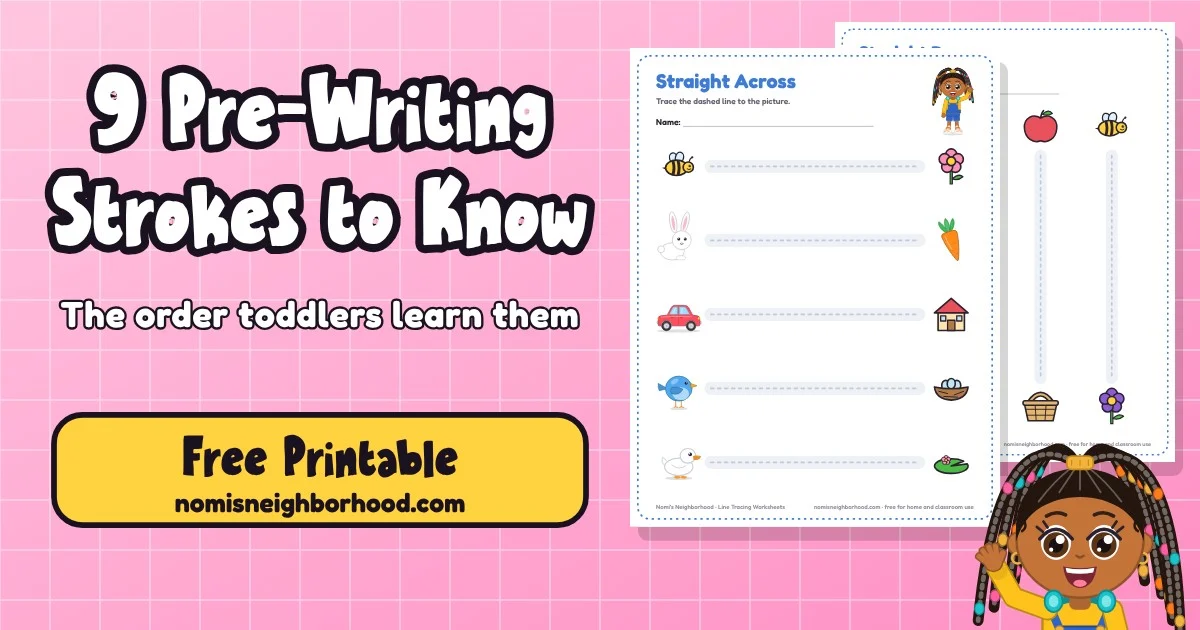
Part of our Early Literacy learning hub: more printables, guides and episodes on this topic.
Pre-writing strokes for toddlers are the basic lines and shapes, like vertical lines, horizontal lines, circles and crosses, that make up every letter and number. Before kids can write an A or a 7, they need to draw these strokes with some control. Most toddlers start with lines around age 2 and build up to circles, crosses and diagonal lines over the next few years.
The good news is that practicing pre-writing strokes looks a lot like play. Rain falling, cars driving on a road, bubbles popping. That's real writing practice for a 2- or 3-year-old.
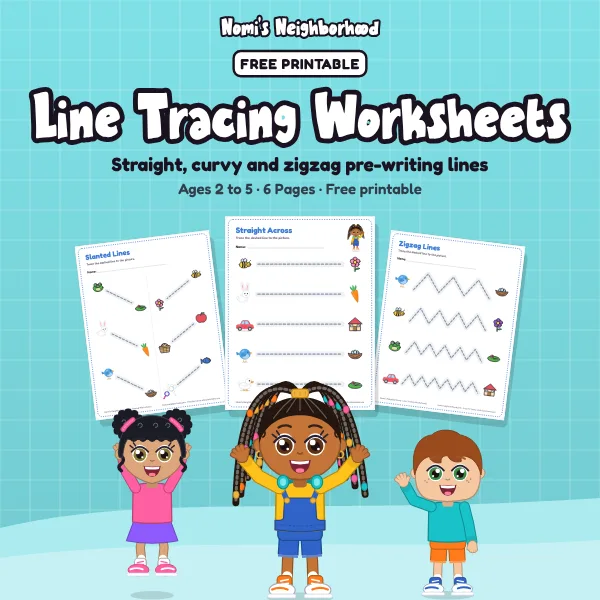
Line Tracing Worksheets
Download FreeWhat Are Pre-Writing Strokes?
Pre-writing strokes are the building blocks of handwriting. Look closely at any capital letter and you'll find them. An E is one vertical line and three horizontal lines. An O is a circle. An X is two diagonal lines that cross.
When a child can comfortably draw these shapes, writing letters later feels much easier. They aren't learning a brand-new skill. They're just putting strokes they already know together in a new way.
The 9 Main Pre-Writing Strokes (in Order)
Kids usually learn these in a rough order, from easiest to hardest. Ages are loose guides. Some kids get there sooner, some later, and both are normal.
- Vertical line (top to bottom), often around age 2
- Horizontal line (left to right), often around age 2 to 3
- Circle, often around age 3
- Cross (plus sign), often around age 3 to 4
- Diagonal line going right (/), often around age 4
- Square, often around age 4
- Diagonal line going left (), often around age 4 to 5
- X, often around age 4 to 5
- Triangle, often around age 5
Kids usually go through three stages with each stroke. First they watch you draw it and try it right away (imitating). Then they can draw it after seeing a finished picture (copying). Finally they can draw it on their own when you name it.
How to Teach Pre-Writing Strokes at Home
Step 1: Start Big
Little kids learn best with big arm movements first. Before paper, try:
- Drawing lines on a steamy bathroom mirror
- Painting with water on the sidewalk
- Making lines with a finger in shaving cream on a tray
- Drawing with chalk on the driveway
Big movements help the shoulder and arm get strong, which supports the smaller hand muscles later.
Step 2: Make It a Story
Give each stroke a fun name:
- Vertical line: "rain falling down"
- Horizontal line: "a road for the car"
- Circle: "a bubble" or "a cookie"
- Cross: "a plus sign" or "a window"
- Diagonal: "a slide"
Kids remember stories better than directions.
Step 3: Model Every Time
Draw the stroke first while your child watches. Then let them try right next to yours. Say the direction out loud: "Start at the top and go down."
Step 4: Move to Tracing
Once your child can make a few strokes freely, try tracing pages. Use worksheets with simple dashed lines to trace. Teach the same three rules we use for letters:
- Start at the top or the left end.
- Go top to bottom.
- Go left to right.
These are the same habits kids will need for writing letters, so it's a great time to start them.
Step 5: Keep It Short
Two to five minutes is plenty for a 2-year-old. A 3- or 4-year-old might enjoy ten. Stop while it's still fun.
Fun Pre-Writing Activities by Stroke
Vertical and Horizontal Lines
- Tape paper to the wall and draw "rain" with crayons
- Drive toy cars along painter's tape roads on the floor
- Pull a ribbon or yarn along a tabletop to make lines
Circles
- Trace around cups and lids
- Draw circles in a salt tray
- Stir "soup" in a pot with a wooden spoon in big circles
Crosses and Diagonals
- Make plus signs with craft sticks
- Draw "slides" for toy figures to zoom down
- Build an X with two pieces of tape on the floor and walk along it
Shapes
- Build squares and triangles with play dough snakes
- Find shapes around the house
Shapes are a natural next step. Our post on shape activities for preschool has lots of hands-on ideas. You might also enjoy watching Nomi's "Shape Bounce" song together, then drawing the shapes you just sang about. You can watch Nomi on YouTube.
Pre-Writing Strokes by Age
Age 2
Focus on scribbling and making marks. Try vertical lines with lots of modeling. Use chunky crayons, finger paint and big paper. Let them explore.
Age 3
Work on horizontal lines and circles. Introduce simple tracing pages with short dashed lines. Many 3-year-olds also start trying a cross.
Ages 4–5
Practice crosses, diagonal lines, squares, X's and triangles. When these feel easy, your child is likely ready to trace letters. Our step-by-step guide on how to teach a toddler to write letters picks up right where this leaves off.
Tools That Make Strokes Easier
- Chunky or broken crayons encourage a better grip than long, thin ones.
- Vertical surfaces like an easel or paper taped to a wall help wrists stay in a good position.
- Sheet protectors over tracing pages let kids practice with dry-erase markers again and again.
- Short sessions mean more good tries and fewer meltdowns.
Build Hand Strength Too
Strokes depend on strong little hands. Mix in squeezing playdough, tearing paper, peeling stickers and picking up small items with tongs (always supervised). We share more of these in our list of fine motor activities for toddlers.
When to Check In
Every child develops at their own pace. If you have questions about your child's hand skills or drawing, your pediatrician or your child's preschool teacher is a good person to ask.
Line Tracing Worksheets
Download FreeFAQ
What are pre-writing skills?
Pre-writing skills are the abilities kids need before they can write letters. They include drawing basic strokes like lines and circles, holding a crayon, using both hands together and having enough hand strength to control a tool.
What order should pre-writing strokes be taught?
A common order is vertical line, horizontal line, circle, cross, diagonal lines, square, X and then triangle. This moves from simple strokes to ones that need more control.
At what age can a toddler draw a circle?
Many children start drawing a circle around age 3, though some do it earlier or later. Before that, they often make round scribbles, which is a great step toward a true circle.
Are pre-writing worksheets good for 2-year-olds?
Most 2-year-olds learn more from big, hands-on play like painting, chalk and finger drawing. Simple tracing pages with short, thick lines can be added when your child shows interest.