Part of our Early Math learning hub: more printables, guides and episodes on this topic.
The best shapes activities for preschool get kids touching, building and moving with shapes, not just naming them on a chart. Try shape hunts around the classroom, building shapes with craft sticks and playdough, sorting blocks by shape, and movement games like hopping to the circle. Start with circle, square, triangle and rectangle, then add more shapes as kids get confident. Below are hands-on ideas grouped by type, plus tips for 3-, 4- and 5-year-olds.
Shapes are a big part of early math. When kids learn to spot, describe and build shapes, they're also building vocabulary and problem-solving skills.
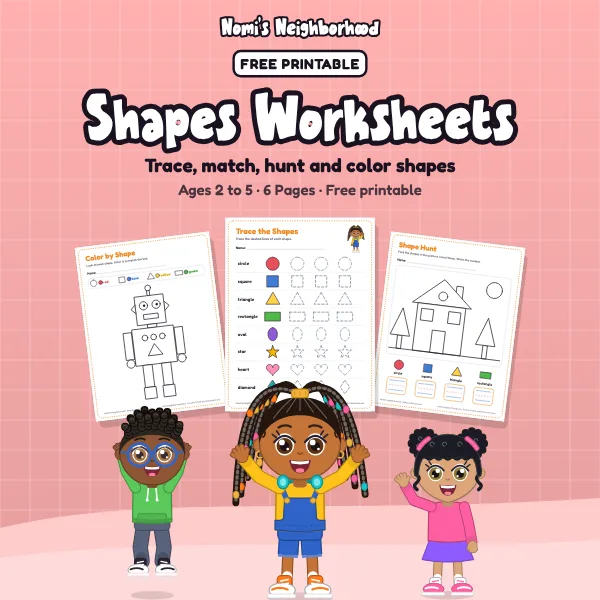
Shapes Worksheets
Download FreeWhich Shapes to Teach First
A simple order works well for most classrooms:
- Circle
- Square
- Triangle
- Rectangle
- Oval
- Star
- Heart
- Diamond (rhombus)
Begin with the first four. They're everywhere in a classroom and in kids' lives. Older 4s and 5s can add the rest.
As you teach, describe what makes each shape special. "A triangle has three sides and three corners." This helps kids understand that a triangle is still a triangle when it's turned or stretched, which is a big idea in early geometry.
Shape Hunt Activities
1. Classroom Shape Hunt
Give each child a picture card of one shape. They walk around the room and find things that match, like a round clock, a square window or a rectangle door.
2. Shape Spy Walk
Take a walk outside or around the school. Look for shapes in signs, wheels, windows and bricks.
3. Shape Detective Bags
Put a few shape blocks in a cloth bag. Kids reach in without looking and guess the shape by feel. Ask, "How did you know?" to build describing words like corners and curved.
Building and Making Shapes
4. Craft Stick Shapes
Give kids craft sticks and let them build squares, triangles and rectangles. Count the sides together.
5. Playdough Shapes
Roll playdough into snakes and form shapes. Or press shape cookie cutters into flat dough.
6. Geoboards
Stretch rubber bands over pegs to make shapes. If you don't have geoboards, push golf tees into foam blocks.
7. Painter's Tape Shapes
Tape large shapes on the floor. Kids walk along the edges, hop inside or drive toy cars around them.
8. Shape Pictures
Give kids precut paper shapes and let them build a picture, like a house from a square and a triangle, or a train from rectangles and circles.
Shape Sorting and Matching
9. Shape Sort Bins
Mix shape blocks or foam shapes in a bin. Kids sort them into labeled trays.
10. Shape and Color Sort
Sort by shape first, then by color. This gets kids thinking about more than one feature. Our post on how to teach colors to toddlers has more color sorting ideas that pair nicely here.
11. Shape Memory Game
Make cards with matching shapes and play a simple memory game in small groups.
12. Shape Puzzles
Simple shape puzzles and pattern blocks let kids fit shapes together and see how they make new shapes.
Shape Movement Games
13. Hop to the Shape
Lay paper shapes on the floor. Call out a shape and kids hop to it.
14. Shape Simon Says
"Simon says draw a circle in the air. Simon says make a triangle with your arms."
15. Shape Freeze Dance
Play music. When it stops, call out a shape and kids freeze standing on that shape.
16. Shape Songs
Songs make shape names stick. Nomi's "Shape Bounce" song is a fun warm-up for shape week, and kids can bounce along and point to each shape. You can watch Nomi on YouTube on your classroom screen before centers.
Shape Art and Sensory Activities
17. Shape Stamping
Dip blocks, cups, sponges or cardboard tubes in paint and stamp shapes on paper.
18. Shape Sensory Bin
Hide foam shapes in rice, beans or sand. Kids dig them out and name them.
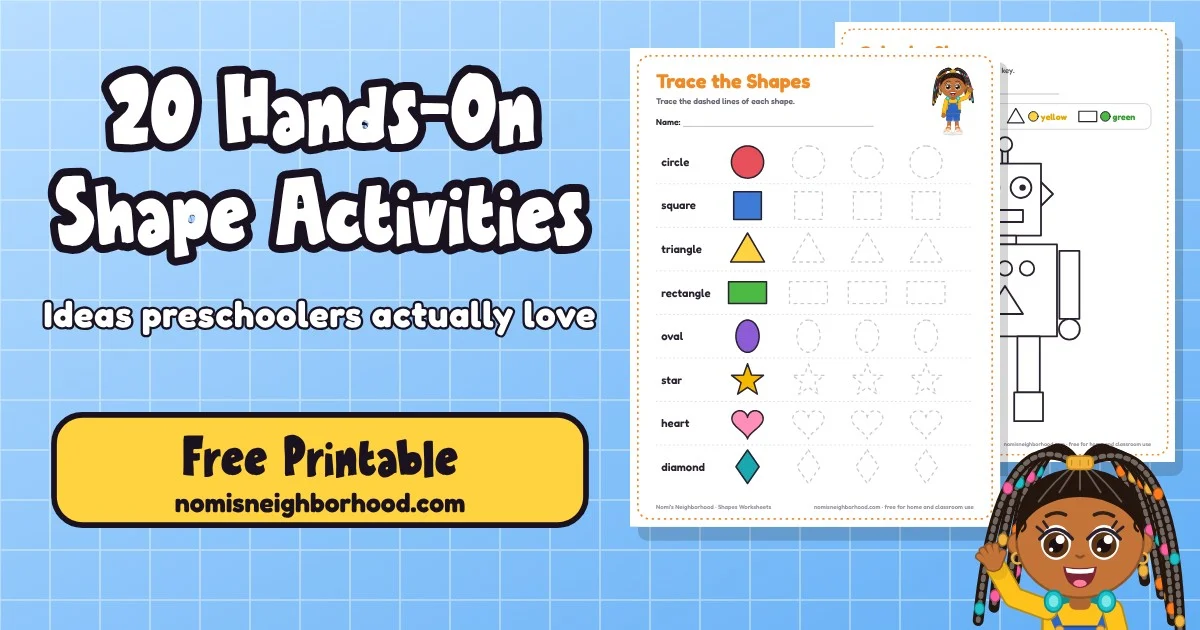
19. Shape Tracing
Trace dashed shapes starting at the top. Shapes like squares and triangles are also pre-writing strokes, so this practice supports handwriting too. Learn more in our post on pre-writing strokes.
20. Shape Snacks
Cut sandwiches, cheese or crackers into shapes. Kids name each shape before eating. Check allergies first.
Setting Up a Shape Center
A shape center can run all week with just a few materials:
- A bin of pattern blocks or foam shapes
- Craft sticks and playdough
- Shape tracing pages in sheet protectors with dry-erase markers
- A shape sorting tray
- Picture books about shapes
Rotate one or two items each day to keep it fresh. For more ways to organize stations, see our post on preschool centers ideas.
Shape Activities by Age
3-Year-Olds
Focus on circle, square and triangle. Use lots of sorting, matching and shape hunts. Kids this age often learn shape names through songs and play more than worksheets.
4-Year-Olds
Add rectangle, oval and star. Start counting sides and corners. Try building shapes with craft sticks and playdough.
5-Year-Olds and Pre-K
Add heart and diamond. Talk about how shapes stay the same when turned. Make shape pictures and simple patterns. Some kids may start noticing 3D shapes like cubes and spheres.
Tips for Teaching Shapes
- Turn shapes around. Show triangles pointing up, down and sideways so kids don't think there's only one "right" triangle.
- Use real words. Sides, corners, curved and straight are great vocabulary words.
- Connect to real life. Pizza slices, doors, wheels and windows make shapes meaningful.
- Repeat across the week. Do a shape hunt Monday, building Tuesday, art Wednesday and so on.
- Keep worksheets short. One page is enough after a hands-on activity.
Shapes Worksheets
Download FreeFAQ
What shapes should preschoolers know?
Many preschoolers learn circle, square, triangle and rectangle first, then add oval, star, heart and diamond. By kindergarten, many kids can name these basic 2D shapes.
How do you teach shapes to preschoolers?
Use hands-on activities like shape hunts, building with craft sticks and playdough, sorting games, movement games and songs. Describe each shape's sides and corners to build understanding.
At what age do kids learn shapes?
Many children start recognizing a few shapes like circles between ages 2 and 3, and learn more basic shapes between 3 and 5. Every child moves at their own pace.
What are good shape games for the classroom?
Hop to the Shape, Shape Simon Says, shape freeze dance, mystery shape bags and shape memory games are all easy, fun and low-prep.